
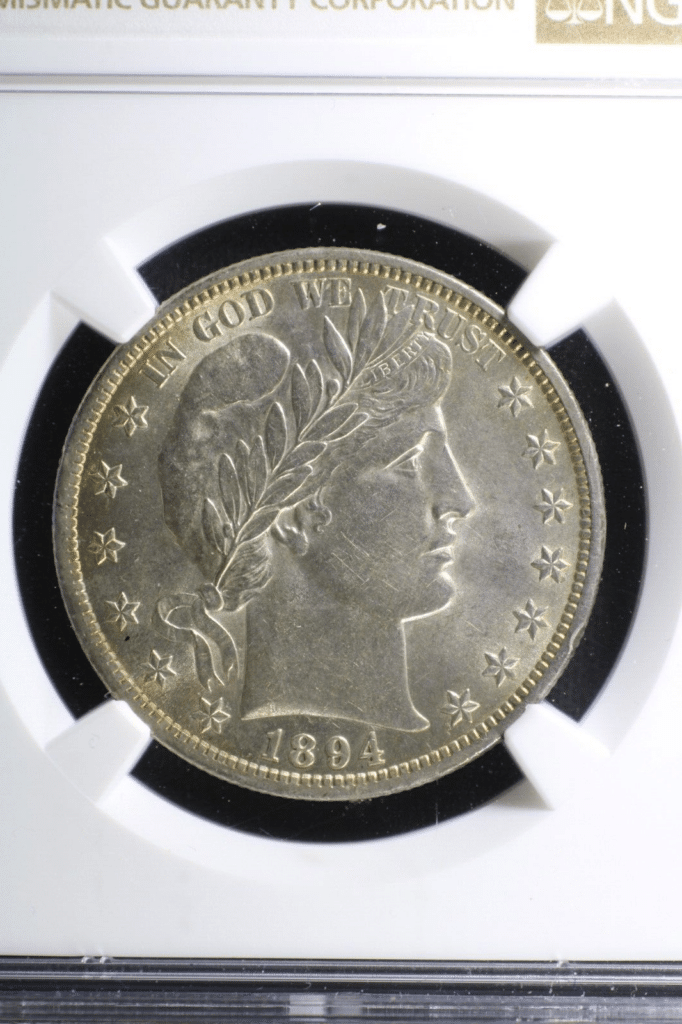
For people interested in coin collecting but unsure where to start, Lincoln cents are often the first recommendation. There are countless varieties. They still show up in circulation, and even young collectors can enjoy searching for them. Another excellent entry point is Barber coins. They are attractive, historically significant, and still affordable compared to many other classic U.S. series.
Barber coins are available in enough quantity that a collector can build a complete year set without overspending. Barber half-dollars are relatively easy to find. Quarters include three more challenging dates, and dimes feature one true rarity, the famous 1894-S.
Overall mintages for Barber coins are quite low compared to later series like Walking Liberty half dollars, Standing Liberty quarters, Mercury dimes, or Washington quarters. For example, the Walking Liberty half-dollar series has just nine coins with mintages under one million, while the Barber half-dollar series has twenty. Combined with their long circulation history, this makes higher-grade circulated Barber coins a rewarding challenge to collect.
What Are Barber Coins?
Barber coins were designed by U.S. Mint engraver Charles E. Barber, who gave the series its name. The term “Barber coins” refers to the dime, quarter, and half-dollar denominations minted from 1892 through 1916.
All three denominations share the same obverse design, so size is the easiest way to tell them apart, along with the details on the reverse. The obverse shows a Liberty Head facing right, wearing a pileus or olive branch crown and a headband inscribed with “LIBERTY.” On the quarter and half dollar, the motto “IN GOD WE TRUST” appears above Liberty’s head. The date sits below her neck, with thirteen six-pointed stars representing the original colonies arranged around the portrait. Because of its smaller size, the dime includes only the Liberty Head, the words “UNITED STATES OF AMERICA,” and the date.
The reverse of the Barber quarter and half dollar displays a heraldic eagle. The eagle holds an olive branch in its right claw and thirteen arrows in its left. A scroll in its beak reads “E PLURIBUS UNUM,” with thirteen stars above the eagle and the coin’s denomination below. The Barber dime reverse is simpler, featuring a wreath of corn, wheat, maple, and oak leaves surrounding the words “ONE DIME.”
Barber coins were widely used in everyday American life for decades, yet many have aged remarkably well. Even though the newest examples are more than 100 years old, they can still look attractive in grades as low as Very Good. That makes it possible to build a collection of classic U.S. coins with real visual appeal without spending a fortune.
The BCCS
Collectors who want to go deeper into the series may want to explore the Barber Coin Collectors’ Society (BCCS). The group brings together collectors and dealers to study Barber coins and discuss the work and influence of U.S. Mint engraver Charles Barber. The BCCS also offers membership resources and events for those interested in learning more.
Today, Barber coins remain relatively underpriced compared to their prices decades ago. That makes them both appealing collecting opportunities and solid entry points for new collectors. If you’d like to learn more or start building a Barber coin collection, contact us. We’re always happy to share our experience and help you get started.
