
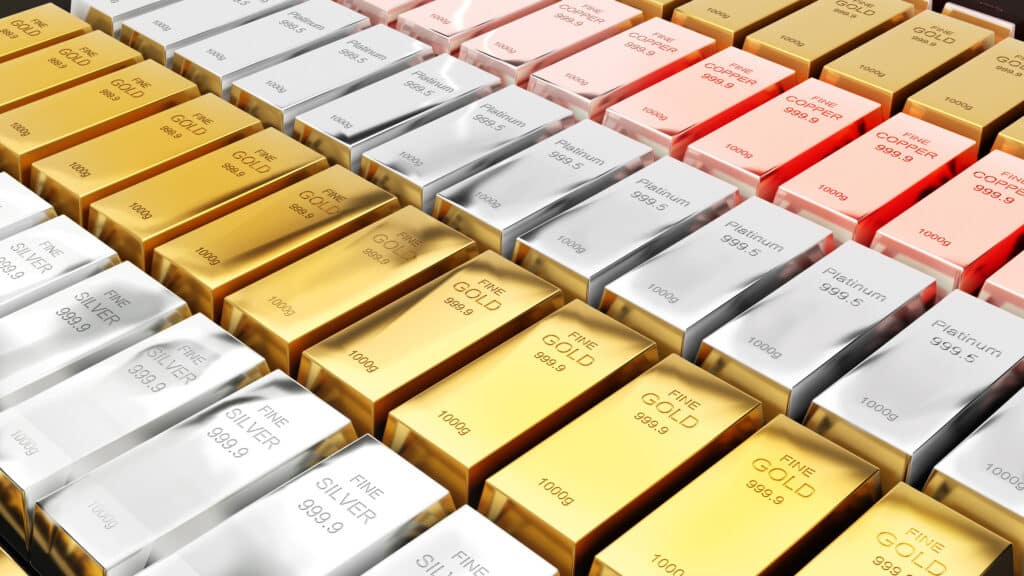
Continuing our discussion of precious metals as an investment, let’s look at bullion and the forces that influence pricing. As a Grand Rapids coin dealer, we see firsthand how gold and silver respond to changing economic conditions, interest-rate cycles, and investor sentiment. Every investor’s situation is different, it’s important to note. We always encourage clients to do their own research before making any investment decisions.
A Precious Metals Investment Strategy
Historical Gold Prices
Gold remains the most common starting point for investors considering precious metals. Historically, gold has tended to perform best during periods of economic slowdown, elevated inflation, currency stress, and broader uncertainty.
When adjusted for inflation, gold reached its all-time high this year. This beats the previous record set in 1980. Since around 2000, gold prices have generally trended higher, with notable pullbacks along the way. In the years following the global financial crisis, the pandemic, and the post-2020 inflation cycle, gold reached multiple new nominal highs.
Gold’s long-term behavior is why many investors continue to view it as a store of value rather than a short-term trade.
Historical Silver Prices
Silver prices have also risen overall since 2000, reaching an all-time high in December of 2025. However, silver’s path has been much less consistent than gold’s. Compared to gold, silver tends to experience larger price swings over shorter periods.
A well-known example came in 2008, when silver saw a roughly 136% price increase within a single year. That volatility is partly due to silver’s lower price per ounce, which makes it easier for investors to buy smaller denominations and enter and exit the market. While this accessibility makes silver appealing, it also means prices can react more sharply to shifts in investor sentiment.
In recent years, including during the pandemic and the early 2020s commodity bull market, silver has been influenced not only by investment demand but also by growing industrial use. Demand tied to clean energy, electronics, and manufacturing has added another layer to silver’s price dynamics heading into 2026 and beyond.
What affects the spot prices of precious metals?
The spot prices of precious metals fluctuate continuously and are shaped by multiple factors simultaneously. For anyone evaluating precious metals as an investment, understanding these drivers is key.
- Precious metals are widely used in industry and manufacturing, including electronics, energy, and medical applications, and changes in industrial demand can influence spot prices.
- Demand for gold and silver jewelry, especially in global markets, also plays a meaningful role in pricing.
- Unlike many commodities, precious metals are often driven more by investor behavior than by supply, meaning decisions to buy, hold, or sell bullion can move prices quickly.
- Inflation expectations, economic uncertainty, and geopolitical tensions continue to push investors toward precious metals as an investment, particularly as a hedge against currency risk.
- Government and central bank activity remain major factors. In recent years, central banks, especially in emerging markets such as China and India, have been consistent net buyers of gold, adding long-term demand that influences overall market prices.
Gold: a volatile asset
Gold prices can be volatile, in part because the market is heavily influenced by futures contracts, derivatives, and short-term speculation. At the same time, gold behaves differently from most commodities. Its relatively low correlation with other commodity prices, along with its trading against fiat currencies during past financial crises, has led many investors to treat gold more like a currency than a raw material.
That distinction is one reason gold continues to play a central role in precious metals as an investment, particularly during periods of economic stress. In recent years, gold prices have been driven by a mix of factors, including currency strength, changes in real yields, and shifting global capital flows, reinforcing its long-standing reputation as a store of value in diversified portfolios.
What’s happening today with bullion?
In 2025 and heading into 2026, bullion prices are being shaped by lingering inflation concerns, changing Federal Reserve interest-rate policy, and ongoing geopolitical uncertainty. After years of post-pandemic tightening and market recalibration, gold continues to attract investors seeking stability, even as others rotate capital back into higher-risk assets in line with economic conditions.
Am I paying too much?
Even when paying the spot price for a precious metal, it’s natural to question whether the timing is right. With precious metals, the price simply reflects current market conditions, not a guarantee of future performance. Decisions around precious metals as an investment ultimately come down to how gold and silver have behaved historically, and how much confidence you have in other investment options given today’s economic environment.
What should I expect from my investment in bullion?
Owning physical gold or silver means holding a tangible asset, or, in the case of an IRA, having it securely held by a qualified custodian. Prices may rise or fall, sometimes sharply, but bullion does not go to zero. While some investors attempt to time the market based on personal outlooks or portfolio needs, precious metals as an investment are typically about long-term preservation rather than short-term prediction.
Central banks across emerging markets continue to diversify their reserves into gold. At the same time, private demand in regions such as South Asia and the Middle East remains strong, both culturally and financially.
Where are the precious metals headed?
As with any investment, no one can predict with certainty where precious metals prices are headed. What has remained consistent over time is their role as a long-term store of value, particularly during periods of inflation, currency pressure, and broader economic uncertainty.
Do foreign investors buy a lot of bullion?
Yes. Governments in countries such as China and India remain active buyers of bullion, and individual investors abroad often turn to gold when confidence in local currencies weakens. In some cultures, especially in India, gold has long been viewed as a trusted store of value.
More broadly, central banks across emerging markets have continued to diversify reserves into gold. At the same time, private demand in regions like South Asia and the Middle East remains culturally and financially strong.
Possible Precious Metals investment strategies:
No single right approach to investing in precious metals exists. The right strategy depends on your goals, time horizon, and overall portfolio.
Common approaches include:
- Buying and holding bullion as a long-term store of value.
- Holding bullion as a percentage of your portfolio and rebalancing annually.
- Using a dollar-cost averaging strategy to spread purchases over time.
- Maintaining a fixed dollar-value position in precious metals.
- Holding bullion as part of a self-directed IRA.
Investing in bullion can be rewarding, but like any investment, it requires due diligence and a clear plan. Having a trusted, knowledgeable advisor makes a difference. If you’re interested in learning more about precious metals as an investment, contact the experts at Grand Rapids Coins to discuss your options.
FAQ on Precious Metals Investing
Q: Are precious metals a good investment in 2026 and beyond?
Precious metals as an investment continue to appeal to investors looking for long-term stability rather than short-term gains. Gold and silver have historically maintained their value during periods of inflation, currency pressures, and economic uncertainty. While prices can fluctuate, many investors use precious metals to diversify portfolios and reduce reliance on traditional financial assets.
Q: Is it better to invest in gold or silver?
Gold and silver serve different roles. Gold is typically viewed as a store of value and tends to be less volatile. This is why conservative investors choose gold. Silver often experiences larger price swings due to its lower price per ounce and industrial demand. This can appeal to investors comfortable with higher volatility. Many portfolios include both to balance stability and growth potential.
Q: Should I buy physical bullion or paper investments?
Physical bullion offers direct ownership of the metal, which appeals to investors seeking tangible assets outside the financial system. Paper investments, such as ETFs, may offer convenience but don’t provide physical possession. For those considering precious metals as an investment for wealth preservation, physical gold and silver are often preferred, especially when held securely or in an IRA.
Q: How much of my portfolio should be in precious metals?
There’s no universal answer, as allocation depends on individual goals, risk tolerance, and time horizon. Many investors choose to hold precious metals as a small percentage of their overall portfolio to help diversify risk. A trusted advisor can help determine an allocation that aligns with your broader financial strategy.
Q: Can precious metals lose all their value?
While prices can rise and fall, precious metals do not go to zero. Gold and silver have retained value across centuries and economic cycles. That durability is a key reason precious metals as an investment are often associated with preservation rather than speculation.
