
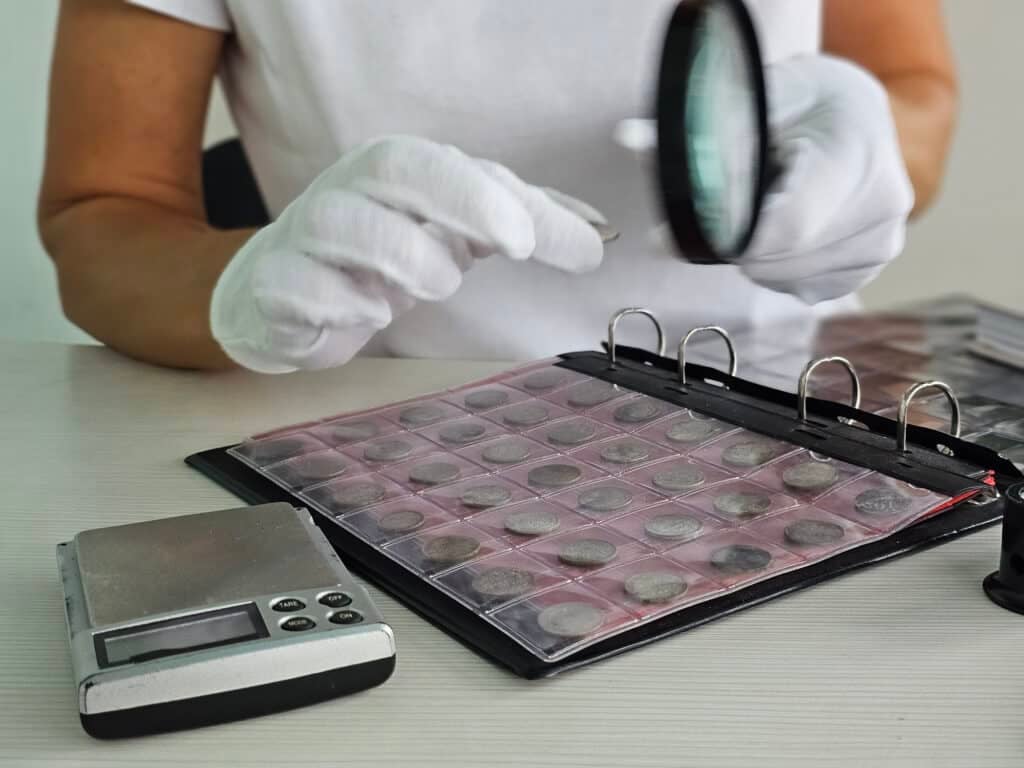
Coin grading is the process of determining the grade or condition of a coin, and it’s one of the most important factors in assessing coin values as collectible items. The coin grading process involves evaluating several key elements: strike, surface preservation, luster, coloration, and overall eye appeal. Once these aspects are considered, a numerical grade is assigned to reflect the coin’s condition.
The Evolution of Coin Grading Standards
The coin grading process has evolved significantly over the centuries alongside the hobby itself. Early grading methods relied on simple one- or two-word descriptions or letter grades. Later, renowned numismatist William H. Sheldon introduced the Sheldon Scale, a 1–70 numerical grading system. Although originally developed for large cents, the Sheldon scale was eventually adopted for all U.S. coin types. This modern grading system, developed by the American Numismatic Association, is thoroughly detailed in James L. Halperin’s How to Grade U.S. Coins.
Longtime collectors may recall when coin grading was handled informally by collectors and dealers. However, during the coin investment boom of the early 1980s when bullion coins were scarce, there was a growing need for reliable, third-party grading. This led to the founding of professional coin grading services like Professional Coin Grading Service (PCGS) and Numismatic Guaranty Corporation (NGC). These services authenticate and assign grades to coins, then “slab” them in tamper-proof plastic holders to preserve condition and boost buyer confidence.
Typically a coin grade combines a letter prefix and a numerical value based on the Sheldon Scale, providing a standardized way to describe a coin’s condition and quality. This hybrid system gives collectors and investors a more precise understanding of a coin’s physical state, rarity, and potential value.
The letter prefix identifies the general type or condition category of the coin:
- PR (Proof): Coins struck with specially prepared dies for collectors, often with mirror-like finishes.
- MS (Mint State): Uncirculated coins that show no wear from circulation.
- AU (About Uncirculated): Coins with minimal wear, often only on the highest points.
- XF or EF (Extremely Fine): Light wear with sharp detail.
- VF (Very Fine), F (Fine), VG (Very Good), G (Good), AG (About Good), P (Poor): These designations reflect increasing levels of circulation wear and decreasing detail.
The Sheldon Scale: Grading Coins from 1 to 70
The number that follows, from 1 to 70, reflects where that coin falls on the Sheldon Scale. For example:
- PR-01: A proof coin that is heavily worn but still identifiable. This is the lowest possible grade.
- MS-70: A mint state coin in perfect condition with no visible flaws under magnification. This is the highest grade a coin can receive.
Together, these identifiers, like MS-65 or AU-58, offer a detailed shorthand for understanding both the quality and preservation of a coin. This dual-grade system has become the standard in modern numismatics, is used by all major grading services, and is essential for fair pricing, trading, and authentication in the collector’s market.
The Coin Grading Process Is Complex
While these grading services are reputable, collectors know that grading is not always black and white. Variations between grading companies—or even between individual graders—can occur, especially with coins in less common grades. That’s why seasoned numismatists often follow the rule: “Buy the coin, not the plastic.” A coin’s visual appeal can sometimes outweigh its technical grade when it comes to resale. Conversely, a high-grade coin with poor eye appeal may be difficult to move.
Whether you’re a new investor or a seasoned collector, understanding the coin grading process is essential to making informed decisions. If you’d like to know more about how your coins measure up, or if you’re considering selling or acquiring graded coins, contact Grand Rapids Coins for a professional evaluation and expert advice.
